
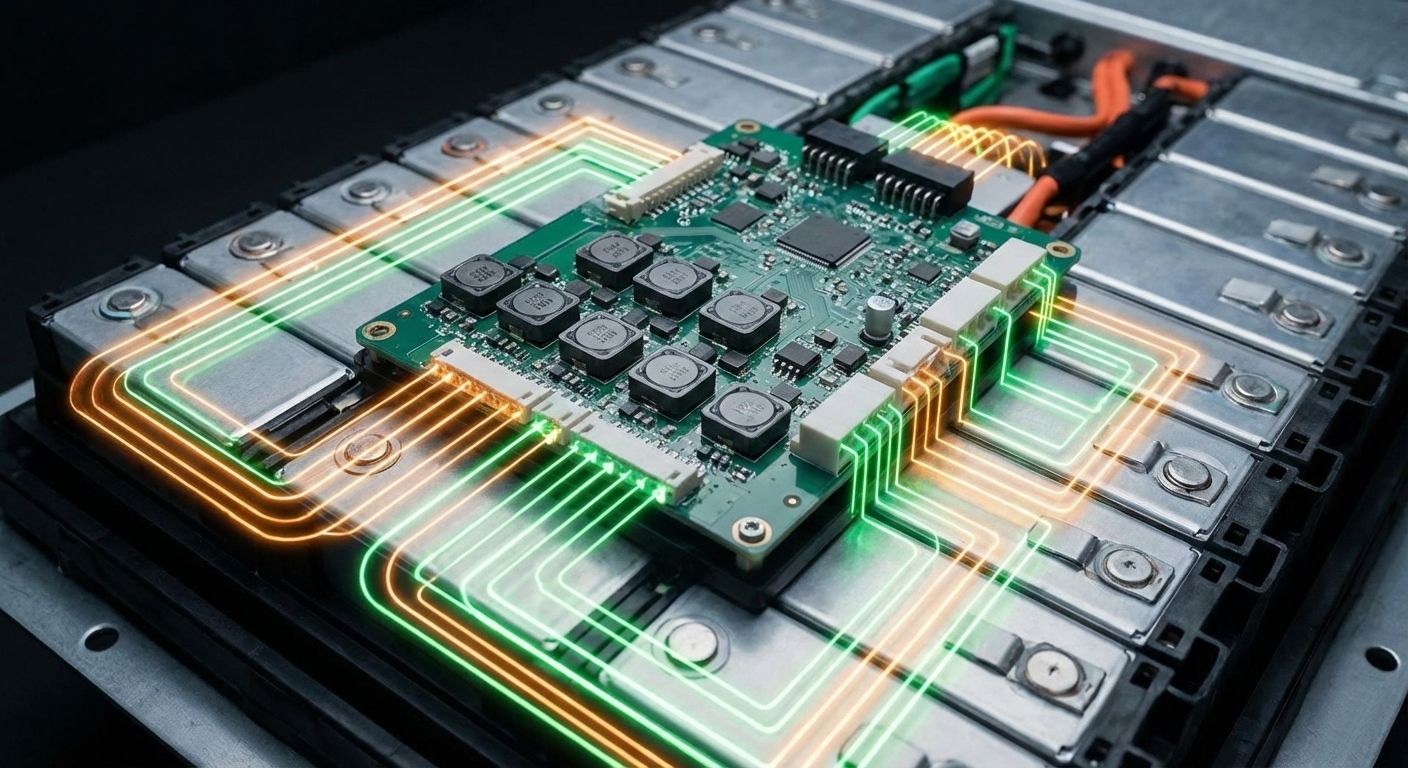
Battery Management Systems (BMS)
Battery Management Systems (BMS) rely on highly reliable DC-DC power conversion to support cell monitoring, balancing circuits, protection ICs, and communication interfaces inside battery packs. Power inductors used in BMS DC-DC converters must operate continuously under elevated temperature, high DC bias, and strict safety and EMI constraints.
This page serves as the BMS-focused DC-DC design hub, linking selection logic, automotive reliability considerations, BMS-specific FAQs, and Coilmaster product families for battery power electronics.
BMS DC-DC Power Design Challenges
DC-DC converters inside battery management systems operate in one of the most thermally and electrically demanding environments in a vehicle. Inductors must maintain stable performance while ensuring long-term safety and reliability.
- Continuous High-Temperature Operation – BMS electronics are often located inside or near battery packs, where ambient temperatures are elevated and heat dissipation is limited.
- High DC Bias and Current Stress – Cell balancing circuits and monitoring ICs draw continuous current, requiring inductors with stable saturation behavior.
- Safety-Critical Power Integrity – Voltage stability directly impacts cell protection, balancing accuracy, and fault detection.
- EMI Control in Dense Battery Electronics – DC-DC noise must not interfere with voltage sensing, isolation monitoring, or communication buses.
Selection Logic for BMS DC-DC Power Inductors
Selecting inductors for BMS DC-DC converters requires evaluation under real battery operating conditions rather than relying on nominal ratings alone.
Core Material Impact on Stability and Accuracy
The choice between Ferrite and Metal Composite cores is a critical design decision for BMS reliability. As shown in our Inductance vs. DC Current analysis, Ferrite cores exhibit "Hard Saturation." When the current exceeds a specific threshold, the inductance suffers a sudden collapse. This leads to unpredictable ripple current spikes, which can interfere with sensitive ADC sampling and degrade cell voltage measurement accuracy.
Our Metal Composite (Molded) inductors provide a superior Soft Saturation profile. Even as DC current increases, the inductance decreases linearly and gradually. This predictable behavior ensures a stable power environment for cell monitoring ICs, supporting the millivolt-level precision required for modern automotive battery packs.
Saturation Current Under High Temperature
BMS inductors must maintain sufficient inductance under DC bias at elevated pack temperatures, where core saturation margin is reduced.
DCR and Thermal Rise
Lower DCR minimizes copper loss and helps control temperature rise in enclosed battery pack environments with limited airflow.
Magnetic Shielding and Noise Immunity
Shielded or molded inductors reduce magnetic coupling into sensitive voltage sense lines and isolation circuits, preventing measurement offsets.
Product Families Commonly Used in BMS DC-DC Applications
The following Coilmaster power inductor families are commonly evaluated for DC-DC power stages in automotive battery management systems.
- Molded High Current Power Inductors – Preferred for BMS designs requiring Soft Saturation to maintain measurement accuracy, low magnetic leakage, and high thermal robustness.
- SMD Shielded Power Inductors – Suitable for compact BMS control boards where EMI margin and layout sensitivity are critical.
- High Current Flat Wire Inductors – Used in higher-power BMS converters where low DCR and reduced copper loss improve efficiency and thermal margin.
Engineering Support
Coilmaster provides engineering support for BMS DC-DC power designs, including DC bias evaluation at temperature, thermal behavior analysis, and EMI risk assessment. Custom solutions and early-stage design support are available for automotive battery and energy storage projects.
- Related Products
68uH 4.44A Shielded Inductor For Noise Filtering with dimension 12*12*7mm
SDS127H-680M-LF
68uH 4.44A SMD Shielded Inductor For Voltage Regulation with dimension 12*12*7mm, a compact powerhouse engineered for high performance and reliability...
Details Add to List1uH, 14A SMD Flat Wire Molded Power Inductors
SEP5030EX-1R0M-LF
Low profile flat wire molded power inductor, SEP5030EX series (3.1mm height), which offers high current handling capacity, low DC resistance and low power...
Details Add to List4.7uH 13A SMD high current inductor
SEP1004EN-4R7M-LF
Introducing our state-of-the-art Alloy Powder Molded Power Inductor, where advanced technology meets compact efficiency. Precision-engineered with a focus...
Details Add to List1000Ω 0.2A ferrite chip bead for signal line
MB1005-102-LF
At Coilmaster Electronics, we understand the importance of signal integrity in your designs. Our 1.1x0.6x0.6mm chip beads with 1000Ω 0.2A are meticulously...
Details Add to List- Related FAQ
Why are DC-DC converters inside BMS more thermally stressed than ECU power supplies?
Battery Management Systems are usually located inside or very close to battery packs, where heat dissipation is limited and ambient temperatures are already...
How does high ambient temperature affect inductor performance in BMS designs?
High ambient temperature reduces magnetic core permeability and lowers saturation current, while also increasing copper resistance. In BMS applications,...
Why is stable inductance important for cell monitoring accuracy?
BMS DC-DC converters supply voltage references and analog front-ends that measure cell voltage, current, and temperature. If the inductor saturates or its inductance...