
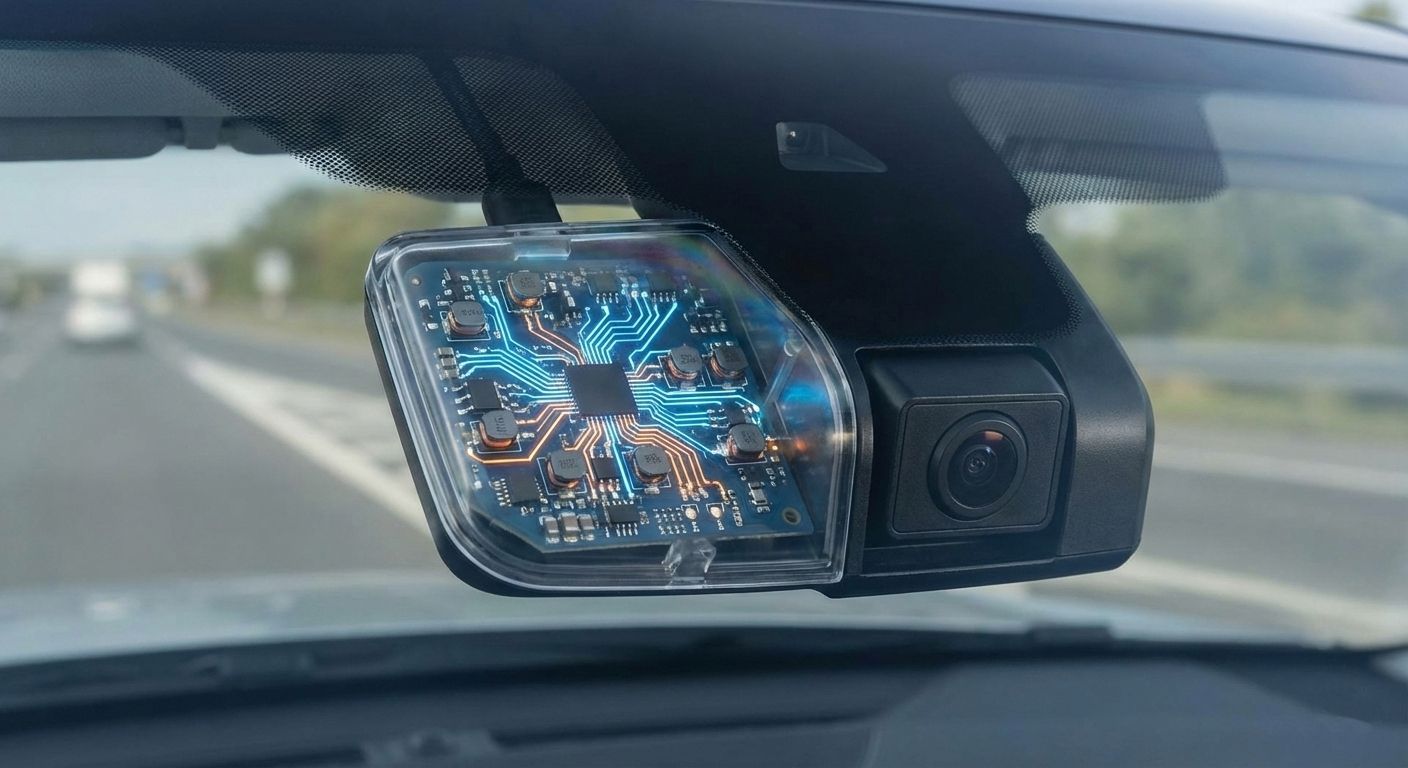
Power supplies for ADAS, camera, and sensor modules
ADAS, camera, and sensor modules rely on stable, low-noise DC-DC power rails to protect signal integrity and ensure consistent performance for safety-related functions. Power inductors in these power stages must control magnetic flux leakage, reduce EMI risk near high-speed interfaces, and maintain stable inductance under temperature rise and transient load conditions.
This page provides system-level guidance for selecting power inductors in ADAS and sensor-module DC-DC applications and links to relevant FAQs and representative product families.
ADAS / Sensor DC-DC Power Design Challenges
Compared to general DC-DC rails, power supplies inside ADAS, camera, and sensor modules are typically more sensitive to EMI and noise coupling because power circuits are placed close to high-speed signal paths.
Key challenges include:
Noise Sensitivity and Signal Integrity
Camera and radar modules may include high-speed interfaces and sensitive analog front ends. Switching noise and magnetic leakage can degrade image quality, sensor accuracy, or communication stability.
EMI Control Near RF / High-Speed Lines
Inductors with higher flux leakage can increase radiated noise, making system-level EMC compliance more difficult, especially when power and signal layers are tightly packed.
Thermal Rise in Compact Housings
ADAS modules are often sealed and space-limited. Low loss and controlled temperature rise are essential to protect nearby ICs and maintain long-term stability.
Transient Load Behavior
Sensor modules can experience fast current transients during processing, communication bursts, or startup events, requiring stable inductance under DC bias and short-term peaks.
Selection Logic for ADAS / Sensor Module Power Inductors
When selecting a power inductor for ADAS, camera, and sensor-module DC-DC converters, evaluation should focus on EMI behavior and real operating conditions, not datasheet values alone.
Shielding Structure and Magnetic Leakage
Shielded or molded inductors help reduce flux leakage and improve EMI performance, especially when placed near antennas, camera FPC/FFC lines, LVDS/MIPI, or sensitive analog circuitry.
DC Bias Stability at Temperature
Inductance drop under DC bias becomes more pronounced at elevated temperature. Verify DC bias curves under realistic ambient and self-heating conditions.
DCR and Thermal Performance
Lower DCR reduces conduction loss and helps control thermal rise inside compact enclosures, supporting stable performance over long operation.
Switching Frequency and Ripple Current
At higher switching frequencies, core loss and AC copper loss can increase. Choose structures and materials appropriate for the target frequency range and ripple current.
Product Families Commonly Used in ADAS / Sensor Power Supplies
The following power inductor categories are commonly applied in ADAS, camera, and sensor-module DC-DC converters. These links provide entry points to representative product families and individual part numbers.
Molded Power Inductors (Low EMI Types)
Preferred for low magnetic leakage and consistent EMI behavior in compact sensor modules.
SMD Shielded Power Inductors
Suitable for space-limited power rails requiring controlled EMI and stable inductance under load.
Multilayer Ferrite Power Inductors
Often used for smaller current rails where compact size and high-frequency behavior are important.
High Current Flat Wire Inductors
Used when higher efficiency and very low DCR are required, typically in larger ADAS processing units.
Engineering Support
Coilmaster provides engineering support for ADAS and sensor-module DC-DC designs, including selection guidance, thermal considerations, and EMI behavior evaluation. If you share key conditions such as input/output voltage, switching frequency, load profile, and EMC targets, we can recommend suitable product families and shortlist parts for validation.
- Related Products
2.2uH 5A Surface mount inductors for power supplies
SEP3015EXS-2R2M-LF
2.2uH 5A High efficiency SMD power inductors sets the standard for compact power management in electronic devices. Featuring a revolutionary flat wire...
Details Add to ListMolding power choke 1uH, 7A
SEP0402EN-1R0M-LF
Our SMD Alloy Powder Molded Power Inductor stands ready to revolutionize your designs with its remarkable capabilities and compact dimensions. At a mere...
Details Add to List12.5uH, 0.9A Smallest SMD Transformer
SDS6035BQXF-120M-LF
Our high-performance coupled inductor series offers a drop-in replacement to Coilcraft LPR6235 series with matching electrical performance, reliable isolation,...
Details Add to List- Related FAQ
Why do ADAS and camera modules require low-EMI power inductors?
ADAS, camera, and radar modules operate next to high-speed data lines, antennas, and sensitive analog circuits. Power inductors with high magnetic leakage...
How does inductor magnetic leakage affect camera and sensor performance?
Magnetic flux leakage from an inductor can couple into nearby signal traces, cables, or antennas. In camera and sensor modules, this interference may appear...
Why is thermal stability important in ADAS DC-DC power stages?
ADAS modules are typically compact and enclosed, limiting heat dissipation. If inductor losses cause excessive temperature rise, inductance and efficiency...