
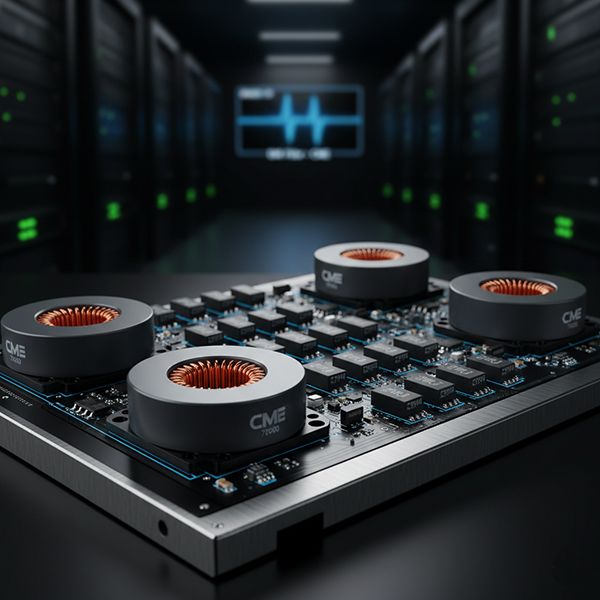
EMI filters for high-speed rails
EMI Filters for High-Speed Power Rails – Common-Mode Chokes, Differential Filtering & Magnetics for VRM, NIC, and Switch Power Integrity
High-speed power rails in AI servers and networking equipment combine high di/dt switching noise with noise-sensitive transceivers. This hub details how to optimize EMI filter architecture using Coilmaster’s SMM, TC, and CMT series to suppress noise without compromising transient response or power integrity.
High-speed platforms (AI servers, 800G switches, and NIC modules) push power density and signal speed to their limits. This combination makes EMI filtering on power rails a mission-critical challenge, as filters must suppress noise without introducing excessive impedance that could destabilize high-speed rails.
This EMI Filters for High-Speed Rails page focuses on building low-noise architectures using Nanocrystalline common-mode chokes and low-leakage magnetics to protect Signal Integrity (SI) and Power Integrity (PI) simultaneously.
Why High-Speed Rails Are Unforgiving
Compared to general industrial power, high-speed rails are constrained by extreme current density and ultra-low noise margins. Even minor EMI oversights can result in bit errors or unstable compute cycles.
- Fast di/dt Transients: GPU/CPU load steps demand tight regulation; filters must not slow down the VRM's response time.
- High Switching Frequency Noise: Modern POL stages generate broadband noise that requires wideband attenuation.
- Signal Integrity Exposure: Magnetic leakage fields can couple into nearby PCIe Gen6, SerDes, and HBM memory interfaces.
- Layout Density: In OCP-compliant designs, power and high-speed lanes are placed in close proximity, increasing the risk of cross-talk.
Multi-Stage EMI Filtering in Computing Architectures
Effective filtering requires strategic placement of magnetics across the power delivery network (PDN):
1. 48V Bus & Server Input Filtering
Utilizing high-current TC/CMT Series with nanocrystalline cores to suppress conducted noise at the rack entry point.
2. Intermediate Bus Filtering (48V to 12V)
Mid-stage filtering prevents DC-DC switching noise from contaminating the server's main power plane.
3. Point-of-Load (POL) EMI Control
The most sensitive zone near the GPU/CPU. Low-DCR SMM Series chokes are used to reduce ripple without causing significant voltage droop.
Recommended Coilmaster Solutions for EMI Filtering
Coilmaster provides high-efficiency structures designed to minimize energy loss while maximizing noise attenuation:
1. High-Current Common-Mode Chokes – TC & CMT Series
Our TC and CMT series offer advanced Nanocrystalline core options. These cores provide significantly higher impedance in a smaller footprint compared to traditional ferrites, with superior thermal stability up to 125°C—ideal for high-density AI server racks.
2. Power Rail SMD Chokes – SMM & SFP Series
For localized filtering on server motherboards, the SMM Series provides a compact, low-DCR solution that suppresses common-mode noise on high-current rails without the energy dissipation of traditional THT components.
3. Low-Leakage Shielded Inductors – SEP-EN & SEP1005A Series
To prevent magnetic field coupling into high-speed data lanes, we recommend the SEP-EN (Molded) and SEP1005A (Assembled Shielded) series. Their closed magnetic circuit design ensures that EMI stays confined within the power stage.
Selection Logic & Customization
We assist engineering teams in balancing attenuation targets with power integrity needs:
- Impedance Curve Alignment: We can tune core materials (Nanocrystalline, Permalloy, Sendust) to match your specific noise spectrum.
- Transient Response Review: Ensuring the filter's DC resistance and parasitic inductance do not worsen voltage droop during GPU load steps.
- Thermal Margin Modeling: Evaluating temperature rise at full 100% compute loads to ensure long-term reliability.
Typical Design Challenges
- Eye-Diagram Jitter: Is power noise coupling into the clock or data path?
- Filter Stability: Does the EMI filter interact with the VRM control loop?
- Near-Field Coupling: Are inductors placed too close to sensitive differential pairs?
- DCR Losses: How much efficiency is sacrificed for noise suppression?
Engineering Support
Coilmaster provides professional validation and material selection to reduce EMI test failure risks.
- Common-mode vs. differential-mode filtering strategies.
- Core material optimization for high-frequency switching.
- Custom footprint and height tuning for space-constrained server blades.
Share your noise target (CISPR/FCC) and rail specs, and we can recommend a best-fit filter set quickly.
Related FAQ
Why is Nanocrystalline preferred for AI server EMI filters?
Nanocrystalline cores offer higher permeability and saturation than ferrites, allowing for much smaller filters that can handle higher currents and temperatures without losing effectiveness.
How do I prevent an EMI filter from affecting VRM stability?
It is crucial to select a filter with low DC resistance and ensure its resonant frequency does not overlap with the VRM’s switching frequency or control loop bandwidth.
Can magnetic leakage from power inductors cause data errors?
Yes. In dense layouts, unshielded or poorly shielded magnetics can couple noise into nearby PCIe or memory lines, leading to jitter and increased bit error rates (BER).
- Related Products
860uH, 4A High Current Leaded Toroidal Inductors
TC2510-861M-4A-LF
A toroidal power coil with a rating of 860uH and 4A is widely used in electronic circuits. It is an insulated coil that is wire wound on a ring-shaped...
Details Add to List0.105uH, 125A Trans-inductor Voltage Regulator Inductor
SBP110511Q-R105L-LF
0.105uH, 125A multiphase buck converter tlvr inductor, in the ever-evolving landscape of data centers, storage systems, graphics cards, and personal computing...
Details Add to List0.2uH, 19A SMD High Reliability Flat Wire Power Inductors
SBP75-R20M-LF
Assembly magnetically shielded power inductor 7.2x7.0x5.0mm, utilize the lowest core losses material and clip to instead of the original cooper wire. This...
Details Add to List- Related FAQ
Why does temperature matter in LAN magnetics?
Heating changes impedance and increases signal distortion.
What typically causes rail noise in AI servers and switches?
High-frequency VRM switching, fast load transients, and coupling through dense power planes.
What role do shielded inductors play in high-speed platforms?
They reduce leakage field coupling into sensitive SerDes, clocks, and memory interfaces.