
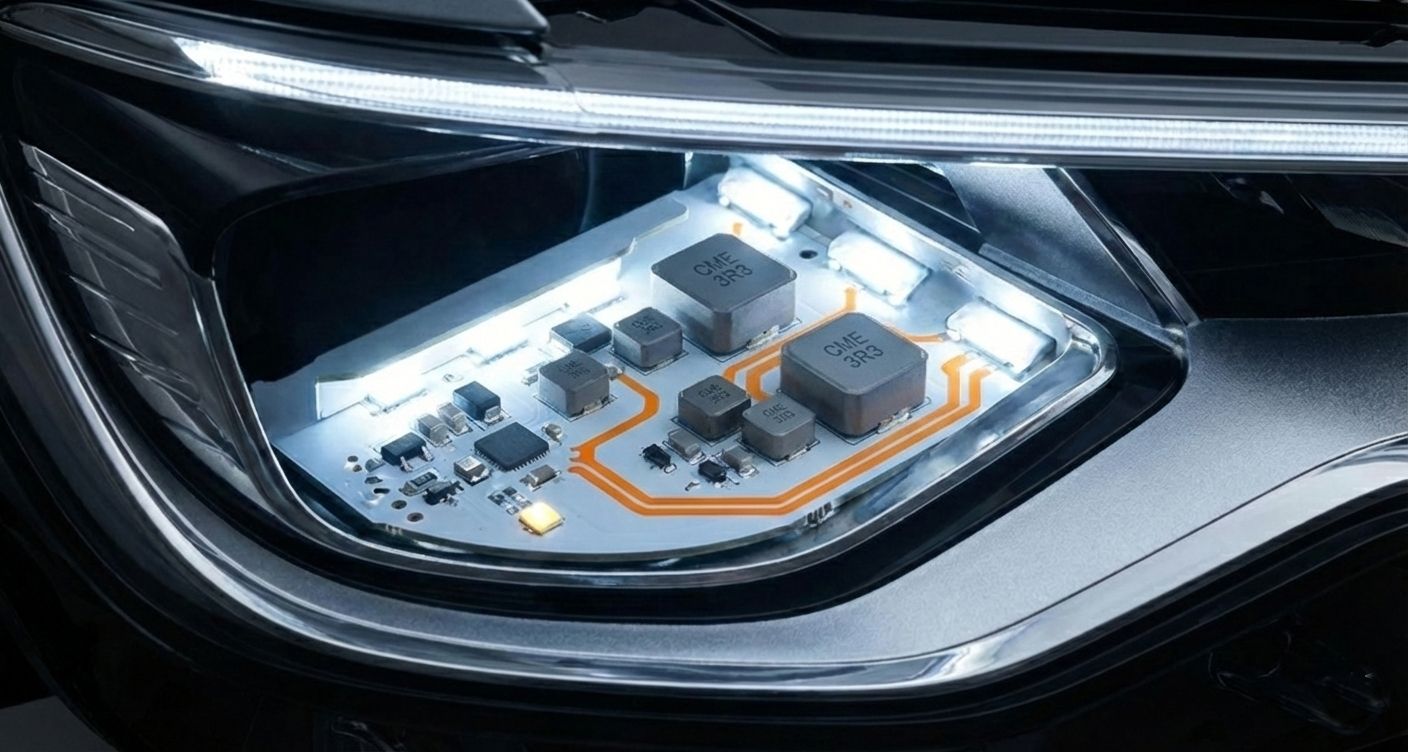
Automotive Lighting DC-DC Power Systems
Automotive lighting systems rely on precise, low-noise DC-DC power conversion to ensure stable brightness, long-term reliability, and electromagnetic compatibility. From headlamps and matrix headlights to tail lamps, ambient lighting, and interior illumination, lighting power stages require inductors that maintain stable current regulation, suppress EMI, and withstand harsh automotive operating conditions.
This application page provides a system-level overview of automotive lighting DC-DC power challenges, selection logic, and design considerations.
Overcoming Power Challenges in Automotive Lighting Systems
Automotive lighting DC-DC converters operate under conditions that differ significantly from ECU or infotainment power rails. Lighting systems must provide accurate current regulation, low ripple, and stable brightness while meeting strict automotive EMC and lifetime requirements.
Brightness Stability and Flicker Control
LED drivers and lighting control modules require stable inductance and low ripple current to prevent visible flicker, brightness drift, and optical artifacts.
EMI Near Vehicle Communication Networks
Lighting power stages often coexist with CAN, LIN, and high-speed automotive buses. Excess magnetic leakage or switching noise can interfere with communication reliability.
Thermal Stress in Enclosed Lamp Housings
Headlamps and rear lamps operate in sealed environments with limited airflow. Power inductors must maintain electrical stability and low loss under elevated temperature.
High Switching Frequency and Fast Transients
Modern LED drivers use high-frequency switching to improve efficiency and dimming control, increasing demands on inductor core loss and AC current capability.
Automotive Lighting DC-DC Application Overview
Automotive lighting DC-DC power conversion spans multiple lighting subsystems within a vehicle. Each lighting domain places different electrical and EMI requirements on power inductors.
Exterior Lighting (Headlamps, Matrix & Adaptive Headlights)
High-power LED drivers for headlights and adaptive lighting systems require inductors with high saturation current, low DCR, and stable inductance to support precise beam control and brightness regulation.
Rear Lamps and Signal Lighting
Brake lights, tail lamps, and turn signals demand reliable current control and EMI suppression to avoid interference with vehicle communication and safety systems.
Interior and Ambient Lighting
Cabin illumination and ambient lighting use compact DC-DC converters where low noise and stable output are critical for consistent brightness and user experience.
Daytime Running Lights and Auxiliary Lighting
DRL and auxiliary lighting modules operate continuously, requiring inductors with excellent thermal stability and long-term electrical reliability.
Each lighting category listed above can be expanded into dedicated subpages covering circuit topology, selection logic, and recommended product families.
Selection Logic for Automotive Lighting Power Inductors
When selecting power inductors for automotive lighting DC-DC converters, system-level behavior is more important than nominal datasheet values.
Saturation Current and Ripple Control
Lighting drivers experience ripple and peak currents during dimming and transient load changes. Inductors must maintain stable inductance under DC bias to prevent flicker and brightness variation.
DCR and Thermal Performance
Lower DCR reduces conduction loss and limits temperature rise in sealed lamp housings, protecting LEDs and driver ICs.
Magnetic Shielding and EMI Behavior
Shielded or molded inductors help minimize magnetic flux leakage, supporting EMC compliance in lighting systems installed close to wiring harnesses and control modules.
Switching Frequency Compatibility
Core material and winding structure must support the operating frequency of LED drivers without excessive core loss or heating.
Why Coilmaster Inductors for Automotive Lighting
Coilmaster automotive power inductors are designed to deliver stable inductance, low EMI, and long-term reliability in lighting DC-DC power stages. Optimized core materials and winding structures support soft saturation behavior, low DCR, and consistent electrical performance across temperature and load conditions.
All automotive-grade products are qualified to AEC-Q200 and manufactured in IATF 16949 certified facilities, ensuring traceability, durability, and production consistency. Coilmaster provides responsive technical support to help lighting engineers select and validate suitable inductors for new vehicle platforms.
Engineering Support for Automotive Lighting Designs
Coilmaster supports automotive lighting DC-DC designs with selection guidance, thermal and EMI evaluation, and application-specific recommendations. Engineers can share operating voltage, LED current, switching frequency, and EMC targets to receive optimized inductor proposals.
- Related Products
22uH Shielded Inductor with rated 1.65A
SDS104-220M-LF
Wirewound fixed Inductors with ferrite core and magnetically shielded construction (with dimension 10.5x10.5x4.8mm). This shielded wirewound inductor with...
Details Add to List10uH 5.5A High current inductor
SEP0603EN-100M-LF
Alloy Powder Molded Power Inductor: where cutting-edge inductive technology meets modern design. Crafted with precision, our inductor stands at a compact...
Details Add to List4.8uH, 13A SMD flat wire inductor
SEP1205A-4R8M-LF
Our SMD Flat Wire Power Inductor is designed to meet your needs. With its compact dimensions of , 13x12.8x5.0mm, a remarkable characterisitc of 4.8uH,...
Details Add to List- Related FAQ
Why are power inductors critical for automotive LED lighting systems?
Automotive LED lighting relies on precise current regulation to maintain stable brightness and avoid flicker. Power inductors are the core energy storage...
Why do automotive lighting DC-DC converters require low-EMI inductors?
Lighting modules are installed close to wiring harnesses, vehicle control units, and communication networks such as CAN and LIN. Excess magnetic flux leakage...
How does inductor performance affect LED brightness stability?
Inductors with unstable inductance under DC bias or temperature rise can cause current ripple and regulation errors in LED drivers. This leads to visible...