
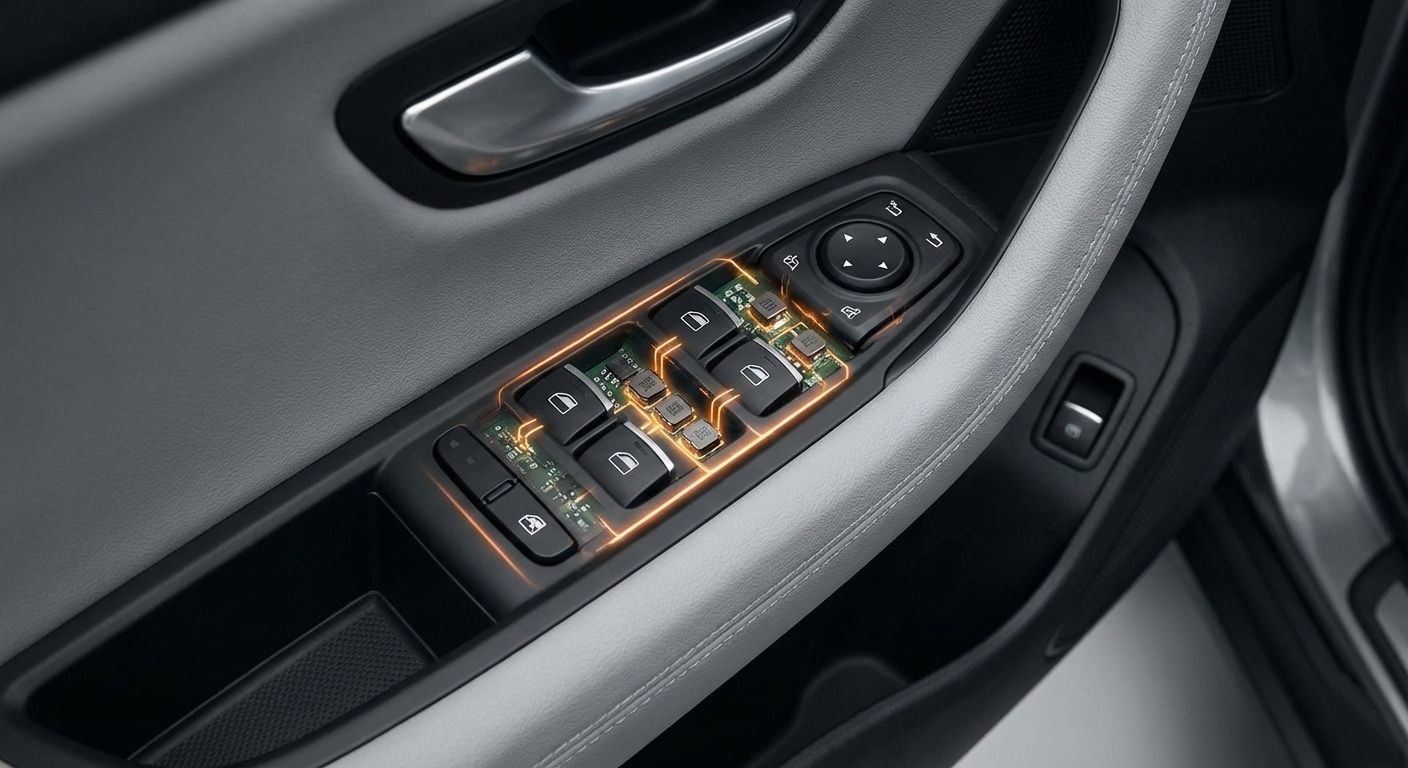
Onboard auxiliary power rails and body electronics
Onboard auxiliary power rails supply DC-DC power to a wide range of automotive body electronics, including door modules, HVAC controllers, seat control units, window motors, lighting control boards, and comfort systems. These power stages require inductors that provide stable inductance, controlled EMI, and high reliability while supporting high-volume, cost-sensitive automotive designs.
This application page provides a system-level overview of auxiliary power rail challenges, selection logic, and inductor design considerations.
Power Challenges in Automotive Body Electronics
Unlike safety-critical ECUs or ADAS modules, body electronics operate across many distributed locations in the vehicle, often with long wiring harnesses and shared power rails. DC-DC converters in these systems must balance cost efficiency, EMI control, and long-term reliability.
Distributed Power Architecture
Body electronics modules are located throughout the vehicle, increasing exposure to noise coupling, voltage drops, and transient disturbances.
EMI on Wiring Harnesses
Switching noise from DC-DC converters can couple into long cable runs, potentially affecting other electronic systems.
Thermal and Environmental Stress
Body modules experience wide temperature variation and mechanical stress over the vehicle’s lifetime.
High-Volume Cost and Size Constraints
These systems are produced in large volumes, requiring compact, reliable, and cost-efficient inductor solutions.
Automotive Auxiliary Power Rail Application Overview
Auxiliary DC-DC power rails support a broad range of body electronics across modern vehicles.
Door, Window, and Seat Control Modules
These systems require stable DC-DC power for motors, sensors, and control ICs, with low EMI to protect nearby communication networks.
HVAC and Climate Control Electronics
HVAC controllers operate continuously and require inductors with good thermal stability and low electrical noise.
Body Control Modules (BCM)
BCMs manage multiple subsystems simultaneously, making stable power delivery and EMI control essential.
Lighting Control Boards
Although LED drivers are covered separately, lighting control boards rely on auxiliary DC-DC rails for logic, communication, and monitoring functions.
Each of these application areas will be expanded into subpages with circuit-level considerations and recommended product families.
Selection Logic for Auxiliary Power Rail Inductors
Inductor selection for body electronics DC-DC converters must balance electrical performance, EMI behavior, and production efficiency.
DCR and Efficiency
Lower DCR reduces power loss and improves thermal performance in compact modules.
Magnetic Shielding and Noise Control
Shielded or optimized magnetic structures help reduce radiated and conducted EMI on wiring harnesses.
DC Bias and Load Stability
Inductors must maintain stable inductance under varying load conditions as multiple subsystems switch on and off.
Mechanical Robustness
Package design and termination strength influence resistance to vibration and thermal cycling.
Why Coilmaster for Automotive Body Electronics
Coilmaster provides automotive-grade power inductors designed for high-volume body electronics and auxiliary power rails. Optimized core materials and winding designs deliver stable inductance, controlled EMI, and low thermal rise across a wide operating range.
All automotive products are AEC-Q200 qualified and manufactured in IATF 16949 certified facilities, ensuring consistent quality, traceability, and long-term reliability for vehicle platforms.
Engineering Support for Auxiliary Power Rail Designs
Coilmaster supports automotive body electronics and auxiliary DC-DC designs with selection guidance, EMI evaluation, and thermal analysis. Engineers can provide operating conditions, load profiles, and EMC targets to receive tailored inductor recommendations.
- Related Products
10uH, 7.5A Low Profile High Current Power Inductor
SEP0804E-100M-LF
SMD shielded molding power inductor SEP0804E series with 4.0mm height and up to 10uH inductance value. Typically the molded power choke need to support...
Details Add to List58uH, 2A Wirewound Toroidal Power Inductor
TC1407-580M-2A-LF
58uH, 2A Toroidal Power Coil, wild used in electronic circuits, is an insulated coil that is wire wound on a ring-shaped form which is made of different...
Details Add to List33uH, 0.9A Pin type power inductor for low cost design
RCB0810-330K-LF
33uH, 0.9A Pin type power inductor for low cost design is wound by round wire and assembled with Ni-Zn ferrite core. With small size and high inductance...
Details Add to List- Related FAQ
Why are auxiliary power rails critical for automotive body electronics?
Auxiliary DC-DC power rails supply door modules, HVAC controllers, body control modules, and comfort systems that operate continuously across the vehicle....
Why do body electronics require low-noise DC-DC power?
Body electronics are connected through long wiring harnesses and shared grounds. Switching noise or magnetic leakage from inductors can propagate through...
How does inductor selection affect long-term reliability in body modules?
Inductors with high DCR or unstable inductance increase thermal stress inside compact modules. Over time, this can accelerate aging of nearby components...